
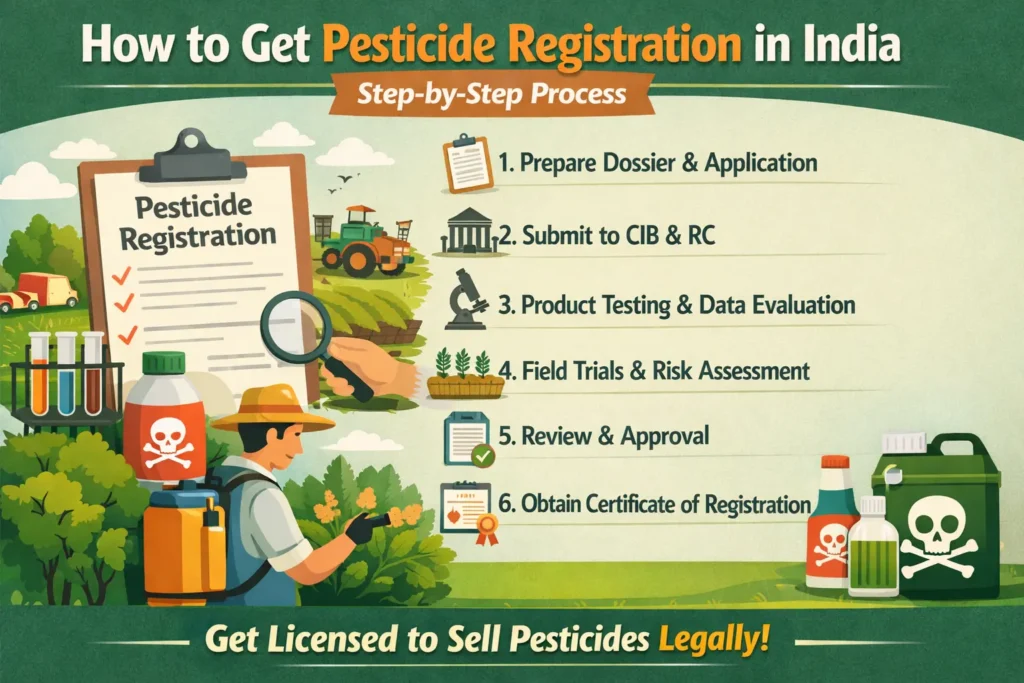
How to Get Pesticide Registration in India – Step-by-Step Process
Introduction to Pesticide Registration in India
The process involves the submission of a pesticide technical dossier, product specifications, toxicity reports, field efficacy and environmental safety reports. As more crop protection products are demanded and enhancing international trade is witnessed, realizing the procedures of CIBRC registration, compliance requirements and legal requirements is very crucial to a company intending to have its crop protection product registered in India as a pesticide.
In India, The Central Insecticides Board & Registration Committee (CIBRC) under the Ministry of Agriculture & Farmers Welfare is the regulatory body of pesticides in India. Manufacturers and importers have to purchase approval prior to distribution or sale of the product whether the product is a conventional chemical, a bio-pesticide or a new active molecule.
Role of the Central Insecticides Board & Registration Committee in India
Central Insecticides Board & Registration Committee (CIBRC) is the peak regulatory body which does the evaluation and approves the pesticides under the insecticides Act, 1968 in India. Under the Department of Agriculture and Farmers Welfare, the CIBRC controls the production, importation, marketing and application of pesticides to ascertain the safety of humans, animals and environment. Anybody interested in marketing pesticides should use the process of registration of pesticides at CIBRC before taking the product to the Indian market.
The Committee evaluates the safety, efficacy and quality of pesticide formulations, active ingredients and technical dossiers. It does this by ensuring that it follows the norms of registration under the insecticides acts and updating stakeholders on the guidelines of regulations. This is whether it is a new molecule registration in India, a bio-pesticide or any agrochemical imported to India, the license application of a pesticide can only be granted after the approval of CIBRC.
A Complete Overview of the CIBRC Registration Process in India
CIBR registration policy is a well-developed route that entails several phases of data analysis and screening operations. Depending on the type of product being registered, applicants are expected to make their selection e.g. Form I should be applied in case of new registration and Form II in case of me-too registration.
In general, they are as follows:
- Filing of the technical pesticide dossier accompanied by scientific information on toxicology, efficacy, environmental safety and chemistry.
- Sending of product samples to be tested in GLP-recognized labs or approved institutes.
- Technical committee review and recommendations.
- Finally, risk-benefit-based approval by the Registration Committee.
The process is applicable to the domestic and pesticide level import registration in India, and it is mandatory in adherence with the safety standards of the country.
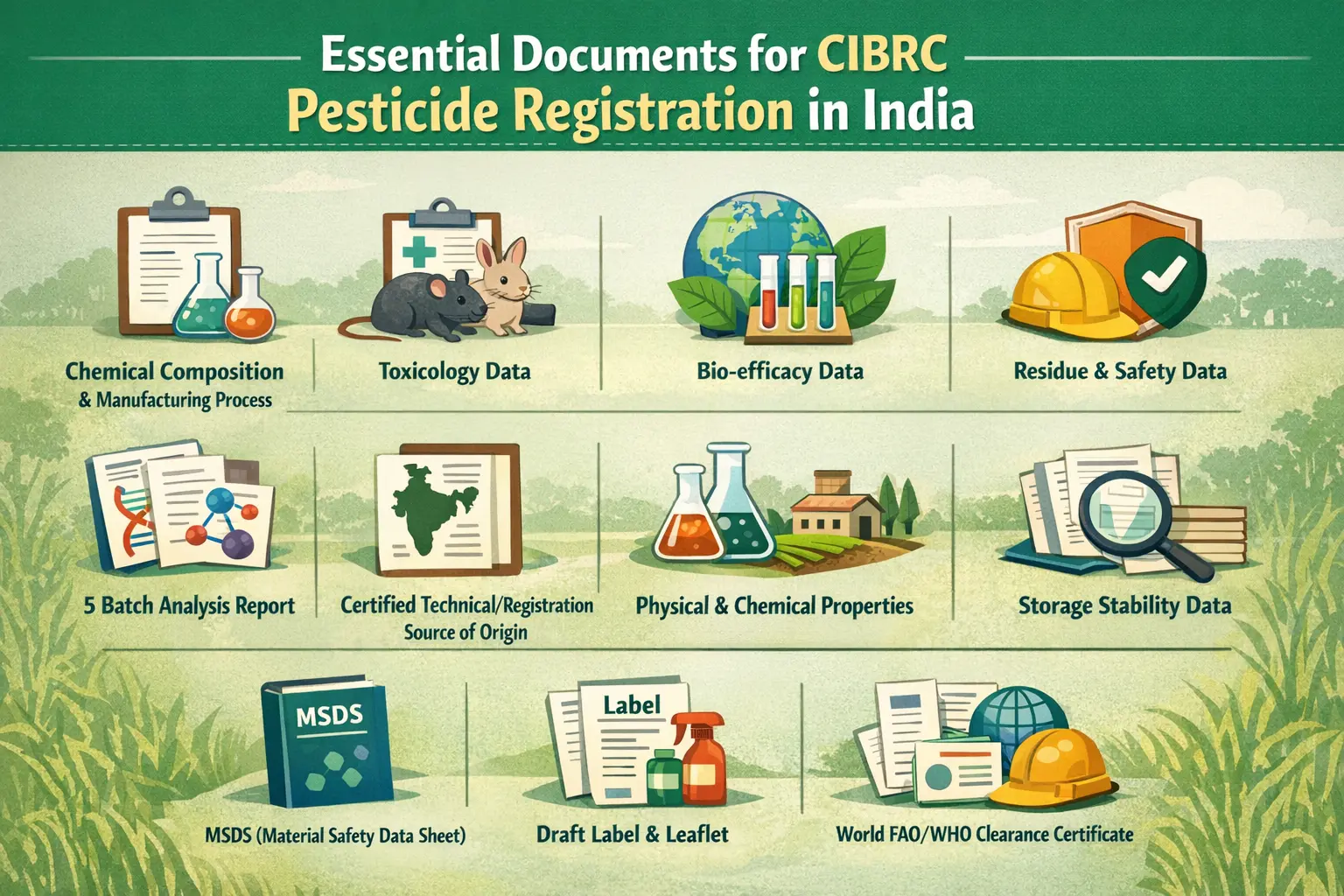
Essential Documents for CIBRC Pesticide Registration in India
To complete pesticide registration in India, the applicant must submit a comprehensive dossier including:
- Duly filled registration form (Form I/II/III as applicable)
- Product chemistry and specifications
- Toxicological and ecotoxicological data
- Bio-efficacy and residue studies from Indian trials
- Label and packaging details
- Good Manufacturing Practice (GMP) certificate
- Manufacturing or import license
- Pesticide technical dossier submission
- Proof of payment of registration fees
These documents are mandatory for registering both conventional and bio-pesticide products under the Insecticides Act 1968 guidelines.
Understanding the Timeline, Cost, and Validity of Pesticide Registration in India
The pesticide registration process in CIBRC varies in terms of length of time and expenses depending on the nature of a product and form used.
Generally:
Timelines: It may require 12-24 months to register an application depending on the level of complexity and the completeness of the dossier.
Fees: Fees are related to the type of application with an extra charge to take tests and to generate data.
Validity: A pesticide registration certificate is valid between 2 and 5 years upon approval and a renewal is subject to the compliance.
Firms that intend to get new pesticide molecule approval, or bio-pesticide registration process or export registration of pesticides need to consider these elements at the earliest stage when planning to register the molecule or pesticides.
How to Register Agrochemicals in India: Step-by-Step Process
Agrochemical registration procedure in India is managed under the insecticides act 1968 that requires all pesticide, herbicide, fungicide or insecticide to be registered by the central insecticides board and registration committee (CIBRC) before they could be manufactured, imported or marketed in the Indian market. Irrespective of whether the product is a technical grade material, a formulation or a new pesticide molecule, the applicant has to adopt a defined registration process.
The CIBRC registration of agrochemicals has the following detailed stepwise procedure simplified as:
- Determine Product Category: Find out whether the product is a new molecule, a generic (me-too), or combination product.
- Choose a Correct Application Form: Form I should be used in regard to any new product; form II should be chosen when a product is already registered; form III should be completed when a product is presented under experimental or provisional registration.
- Technical Dossier: must contain information on product chemistry, toxicology, eco-toxicity, bio-efficacy, residue and shelf-life in accordance with agrochemical registration requirements.
- Carry out Mandatory Trials: The trials shall be conducted in the GLP-certified or ICAR approved trial centres in various agricultural climatic zones in India.
- Handover Dossier and Samples to CIBRC: All the documentation, trial reports and physical samples of the product are presented to CIBRC.
- Technical Experts review: data is reviewed in scientific panels on terms of safety, efficacy and compliance.
- Approval: The CIBRC approves the pesticide and gives a pesticide registration certificate, upon which it is legally manufactured or imported.
- Post-Registration Compliance: Obtaining label approvals; periodic safety reports and any changes to the Insecticides Act registration would have to be met.
The same procedure may also be utilized (with certain modifications) in the cases of pesticide import license India, bio-pesticide registration and FCO registration India in the context of dual-purpose inputs.
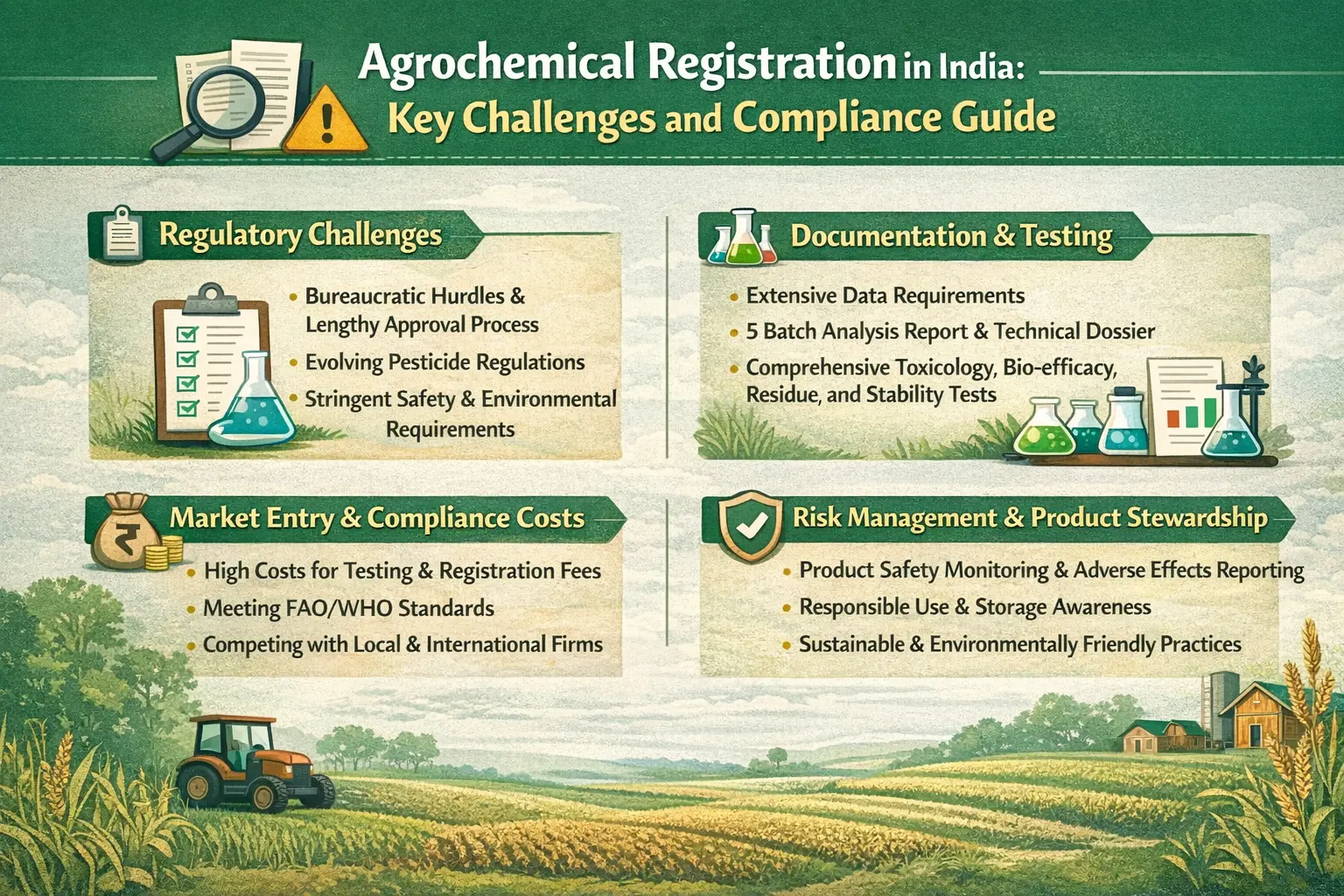
Agrochemical Registration in India: Key Challenges and Compliance Guide
The registrations of agrochemicals in India are complicated by their stringent regulatory, scientific and procedural requirements. These are normal problems and how to surmount them:
Challenge 1: Incomplete Submission of Dossier
In India in order to have a compliant and complete technical dossier, hire an expert pesticide registration consultant.
Challenge 2: Lengthy Reviewing Periods
Send all the necessary information simultaneously, do not forget about the documents, and answer any questions of the CIBRC quickly to avoid delays.
Challenge 3: Trial Non-Compliance
In order to be assured of acceptance of bio-efficacy data and toxicological reports do field tests in government approved labs.
Challenge 4: Complicated Requirements of foreign entities
International pesticide compatibility and the registration of pesticide importer in India Having worked through a local agent or partner, the foreign company is also required to go through a number of other procedures.
Challenge 5: Regulatory Update
Keep abreast with updated Insecticides Act 1968 regulations and CIBRC notifications as needed to ensure consistency through the entire life of a product.
A pro-active approach is useful to overcome such difficulties particularly on the part of startups, manufactures, and exporters interested in registering pesticide exports in India or internationally.
Certification & Registration Services
The present system of registration of pesticides in India supports different types of products- such as new molecules, imported agrochemicals, bio-pesticides, and fertilizer-based commodities all of which are regulated differently. These approvals are managed by the Central Insecticides Board & Registration Committee (CIBRC) under the Insecticides Act, 1968, whereas FCO registration India falls in the hands of a different regulatory group, which is the fertilizer-grade products. The types of registrations which are important to agrochemical businesses are listed below:
New Agrochemical Molecule Registration in India: Process & Approval
One of the strictest regulatory paths in India is the registration of new molecules, with sizable amounts of toxicology, environmental safety and field efficacy studies. A pesticide active ingredient which has never been registered in India will have to pass Form I application and complete submission of pesticide technical dossier.
The main requirements are:
- Complete chemical analysis and production process
- Toxicological tests according Indian and international standards
- Multi site bio-efficacy field and residue trials
- Packaging, labeling and stability data
- Slow processing delay (i.e. usually 18-36 months)
- CIBR characteristic to approve safety or risk-benefit analysis
New applications to approval of pesticide molecules can only be done by the original data generator (or the licensed individuals) and this will protect intellectual rights and standards of international pesticide compliance requirements.
Pesticide Import Approval in India: Registration and Compliance Process
Registration of pesticides in India is required of foreign firms or Indian distributors interested in introducing foreign based agrochemical products in the country. This is a Form I or Form II, which includes the molecule being new or registered.
Import process of pesticide license India:
- Appoint an Indian agent/ Subsidiary to represent the foreign manufacturer
- Please submit an elaborate dossier where groups of certificates/offerings are to be provided; Certificate of Analysis, Free Sale Certificate and sample of the product.
- Arrange full toxicology and bio-efficacy data and submission according to Indian standards
- Pay related fee and get CIBRC reviewed
Requirements by importers concerning international compliance of pesticides are only possible as well as maintenance of laboratory traceability and labeling after registration.
Bio-Pesticide Approval and Registration Process in India
In India, the registration of a bio-pesticide is rather simplified though it is not deprived of the scientific aspect. Pesticides can be bacterial, botanical, or biochemical which must be registered on a registration system provided under the Insecticides Act albeit with some changes to the data requirements stipulated.
In order to be registered in India as bio-pesticide it is required that the applicant must submit:
- Microbial identity and purity results
- Mechanism of action, as well as composition of the formulation
- Bio-efficacy trials on Indian agro-climatic regions
- Environmental-effect information and Non-target-organism safety information
- Shelf-life, storage and labeling requirements
These are filed through form I, and the time bucket is less as opposed to synthetic products. The process favors innovation in the area of organic and sustainable farming.
FCO Registration Process in India for Fertilizer Substances
When an agrochemical or a bio-input falls under the definition of a fertilizer or a soil amendment, it must be registered in India under the FCO, which is the fertilizer (Control) order of 1985, instead of the Insecticides Act. Such a case can be applied to such products as the zinc-based micronutrients, the bio-fertilizers, or the fortified organic inputs.
In order to be a register under FCO:
- The applicants can apply either through the State Agriculture Department or Central Government according to the product category
- Through a technical dossier submit chemical composition, efficacy, and soil impact dossier
- Make product samples available to do tests in the laboratory
- Consider the labeling, storage and transport requirements produced by the FCO
This registration path is also active when registering pesticides together with dual-purpose product registration which applies to plant nutrition and pest control.
Pesticide Manufacturing License in India for Startups and Companies
The licensure of pesticides in India is an obligatory legal demand of those manufacturers and startups that intend to initiate their operation in the agrochemical business. According to its Insecticides Act, 1968, no organization has the authority to manufactory, sell, distribute or import pesticides without being registered and licensed.
The Central Insecticides Board & Registration Committee (CIBRC) is the major authority of the process of pesticide application evaluation and provision of the registration certificate. The application for pesticide license to startups and new manufacturers should be detailed in case it includes the technical dossier, technical safety, field usefulness information, manufacturing architecture presentation, and product labels according to the requirements.
To first-time players, the intricacy of the procedure, specifically in the case of a new molecule of pesticide, registration of bio-pesticide or formulations of two or more, may be too cumbersome to cope with professionally.
Global Pesticide Regulations for Exporters and Importers
The firms that do global trade have to comply with the Indian and international pesticide compliance models. Exporters should also comply with the regulatory requirements of the importing country, including EU REACH, US EPA, etc. and importers will have to obtain a pesticide import registration in India after submitting technical documents, regulatory approvals and safety certificates.
To enable the registration of pesticides export successfully, proper labeling, the traceability, and quality are important. In the case of foreign manufacturers, a license to import pesticides in India has to be obtained with the help of an Indian agent supervised by CIBRC.
How a Consultant Can Help with Pesticide Registration in India
The agrochemical industry is considered one of the highly regulated industries worldwide and therefore, having a reputed pesticide registration consultant in India may be a great asset to have. The consultants help in preparing data, and dossier, compliance checks, trial coordination and also provide regulatory representation. Their assistance is very useful to the startups and foreign companies that are exploring the Indian scene of registering agrochemicals especially at the initial stages to prevent delays and rejections in the licensing processes. United Enterprise is one of the best consultants in India for the same.
Frequently Asked Questions
Pesticide registration in India involves submitting an application and technical dossier to the CIBRC for scientific evaluation, testing, and approval under the Insecticides Act, 1968.
The Central Insecticides Board & Registration Committee (CIBRC) is the designated authority for pesticide registration in India.
Required documents include a completed application form, technical dossier, safety data, efficacy reports, product labels, and proof of manufacturing or import.
The registration process typically takes between 12 to 24 months, depending on the product type and data availability.
Fees vary based on the category and type of registration, ranging from ₹5,000 to over ₹2,00,000 as per CIBRC norms.
Yes, field efficacy data is mandatory for most pesticide registrations to ensure product performance under Indian agricultural conditions.
Form I is used to register a new pesticide molecule or formulation, while Form II is for registering an already approved product by a different registrant.
Yes, foreign companies can register pesticides in India through an authorized Indian representative or agent.
A pesticide registration certificate is generally valid for 2 to 5 years, depending on the product and type of registration.
Bio-pesticides are registered by submitting microbial characterization, efficacy, and toxicology data under the Insecticides Act, 1968.