
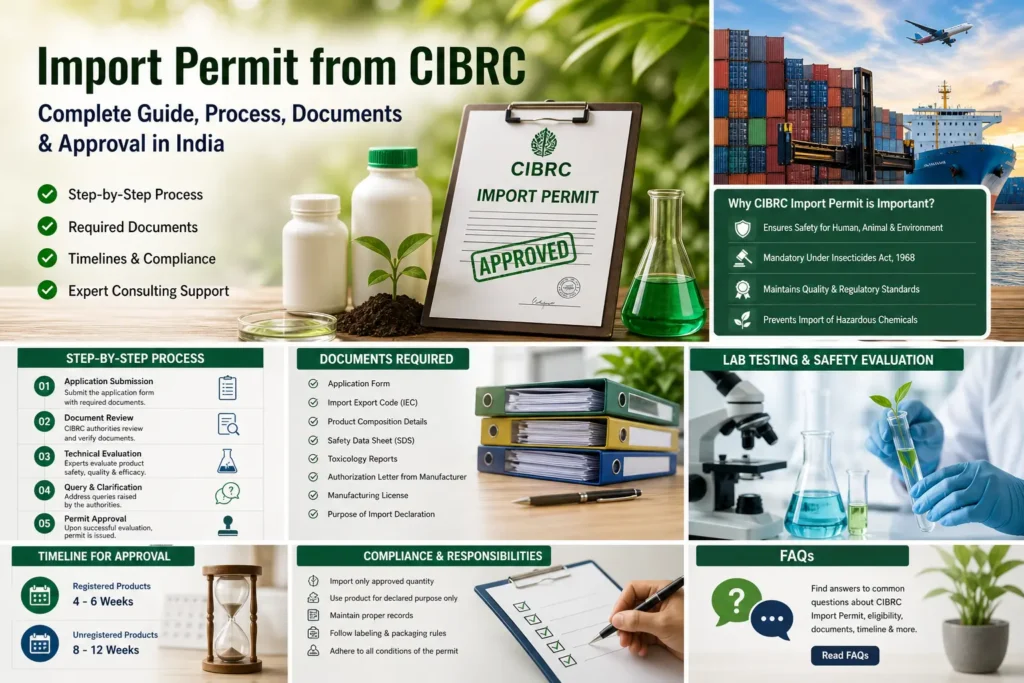
Introduction to CIB&RC and Agrochemical Regulatory Services
An Import Permit from CIBRC (Central Insecticides Board & Registration Committee) is a critical regulatory requirement for businesses dealing with the import of insecticides, pesticides, and agrochemical products in India. We understand that navigating the approval process can be complex, but with the right approach, documentation, and clarity, obtaining this permit becomes straightforward and efficient.
This guide delivers a comprehensive, step-by-step breakdown of the entire process, eligibility, required documents, timelines, and compliance standards necessary to secure an import permit from CIBRC successfully.
What is CIBRC and Why Import Permit is Mandatory
The Central Insecticides Board & Registration Committee (CIBRC) operates under the Ministry of Agriculture & Farmers Welfare, Government of India. It regulates the import, manufacture, sale, transport, distribution, and use of insecticides to ensure safety, efficacy, and environmental protection.
Any entity planning to import insecticides must obtain a valid import permit under the Insecticides Act, 1968, making compliance non-negotiable.
Key Objectives of CIBRC
- Ensure safe use of insecticides
- Prevent hazardous chemicals from entering the Indian market
- Maintain quality standards
- Protect human health, crops, and environment
Who Needs an Import Permit from CIBRC
We identify that the following entities must apply for a CIBRC import permit:
- Agrochemical companies
- Importers of technical grade insecticides
- Research institutions importing samples
- Manufacturers sourcing raw materials internationally
If your business involves bringing insecticide products into India, this permit is mandatory.
Types of Import Permits Issued by CIBRC
We identify that the following entities must apply for a CIBRC import permit:
- Agrochemical companies
- Importers of technical grade insecticides
- Research institutions importing samples
- Manufacturers sourcing raw materials internationally
If your business involves bringing insecticide products into India, this permit is mandatory.
1. Import Permit for Registered Insecticides
This applies when the product is already registered in India. The process is relatively simpler with reduced documentation requirements.
2. Import Permit for Unregistered Insecticides
Required for:
- Research & Development (R&D)
- Trial purposes
- Export manufacturing
This category requires additional approvals and justifications
Step-by-Step Process to Obtain Import Permit from CIBRC
Step 1: Application Submission
We begin by submitting the application in the prescribed format along with required documents to the Registration Committee Secretariat.
Step 2: Documentation Review
Experts analyze:
- Toxicity levels
- Environmental impact
- Efficacy of the insecticide
Step 3: Technical Evaluation
Required for:
- Research & Development (R&D)
- Trial purposes
- Export manufacturing
This category requires additional approvals and justifications
Step 4: Approval or Query
If compliant, the permit is issued. Otherwise, queries are raised, requiring clarification.
Step 5: Permit Issuance
Upon successful review, the import permit is granted with specific conditions and validity.
Essential Documents Required for CIBRC Import Permit
We ensure that all documents are prepared accurately to avoid delays:
- Covering Letter
- Application Form
- Certificate of Registration (if applicable)
- Detailed Product Composition
- Toxicology Reports
- Safety Data Sheet (SDS)
- Manufacturing License
- Import Export Code (IEC)
- Authorization Letter from Manufacturer
- Purpose of Import Declaration
Incomplete or incorrect documentation can lead to rejection or significant delays, so precision is critical.
Eligibility Criteria for Import Permit
To qualify for a CIBRC import permit, we ensure:
- The applicant holds a valid IEC (Import Export Code)
- The product complies with Indian regulatory standards
- Proper technical documentation is available
- The purpose of import is clearly defined
Timeline for CIBRC Import Permit Approval
The processing time varies depending on the type of application:
- Registered Products: 4 to 6 weeks
- Unregistered Products: 8 to 12 weeks
- R&D Imports: May vary based on evaluation complexity
Timely submission of accurate documentation significantly reduces approval time.
Common Challenges and How We Overcome Them
1. Documentation Errors
We ensure zero-error documentation by cross-verifying all submissions.
2. Regulatory Compliance Issues
We align every application with current CIBRC guidelines.
3. Delays Due to Queries
We proactively address potential queries before submission.
4. Technical Data Gaps
We assist in compiling complete scientific and safety data.
Compliance Guidelines After Obtaining Import Permit
Once the permit is issued, strict compliance is required:
- Import only the approved quantity
- Use the product strictly for the declared purpose
- Maintain proper records of usage and distribution
- Follow labeling and packaging regulations
Non-compliance can result in penalties or cancellation of permit.
Benefits of Obtaining CIBRC Import Permit
We emphasize the strategic advantages:
- Legal authorization to import insecticides
- Access to high-quality international products
- Strengthened market credibility
- Compliance with government regulations
- Ability to expand business operations in agrochemical sector
Best Practices for Faster Approval
We follow proven strategies:
- Prepare complete and accurate documentation
- Ensure product compliance with Indian standards
- Submit clear purpose justification
- Maintain consistent communication with authorities
Role of Expert Consultants in CIBRC Import Permit
Navigating regulatory frameworks requires expertise. We streamline the process by:
- Handling documentation and application filing
- Providing technical compliance support
- Managing regulatory communication
- Ensuring faster approvals with minimal errors
Conclusion
Securing an Import Permit from CIBRC is a vital step for businesses involved in agrochemical imports. With a structured approach, proper documentation, and adherence to regulatory requirements, the process becomes efficient and predictable.
We ensure that every stage—from application to approval—is handled with precision, enabling smooth import operations and full compliance with Indian laws. By following this detailed guide, businesses can confidently move forward in obtaining their CIBRC import permit and expanding their market presence in India.
FAQs on CIBRC Import Permit
An Import Permit from CIBRC is an official approval required to import insecticides, pesticides, or agrochemical products into India. It is issued under the Insecticides Act, 1968 to ensure that imported products meet safety and regulatory standards.
Any individual or business involved in importing insecticides into India must apply, including:
- Agrochemical companies
- Importers and distributors
- Manufacturers sourcing raw materials
- Research institutions
There are mainly two types:
- For Registered Insecticides – Easier approval process
- For Unregistered Insecticides – Used for research, trials, or export purposes
Key documents include:
- Application form
- Import Export Code (IEC)
- Product composition details
- Safety Data Sheet (SDS)
- Toxicology reports
- Manufacturer authorization letter
The approval timeline typically is:
- 4–6 weeks for registered products
- 8–12 weeks for unregistered products
Delays may occur if documentation is incomplete.
Yes, a valid Import Export Code (IEC) is mandatory for submitting the application and importing goods into India.
Yes, but only for specific purposes such as:
- Research and development
- Testing and trials
- Export manufacturing
Strict approval conditions apply.
Importing without a valid CIBRC permit can result in:
- Legal penalties
- Confiscation of goods
- Business restrictions
Compliance is mandatory under Indian law.
Yes, applications can be rejected due to:
- Incomplete documentation
- Non-compliance with safety standards
- Incorrect product details
Proper preparation significantly reduces rejection chances.
The validity depends on the type of permit and purpose of import. It is generally issued for a specific quantity and time period, as mentioned in the approval.