
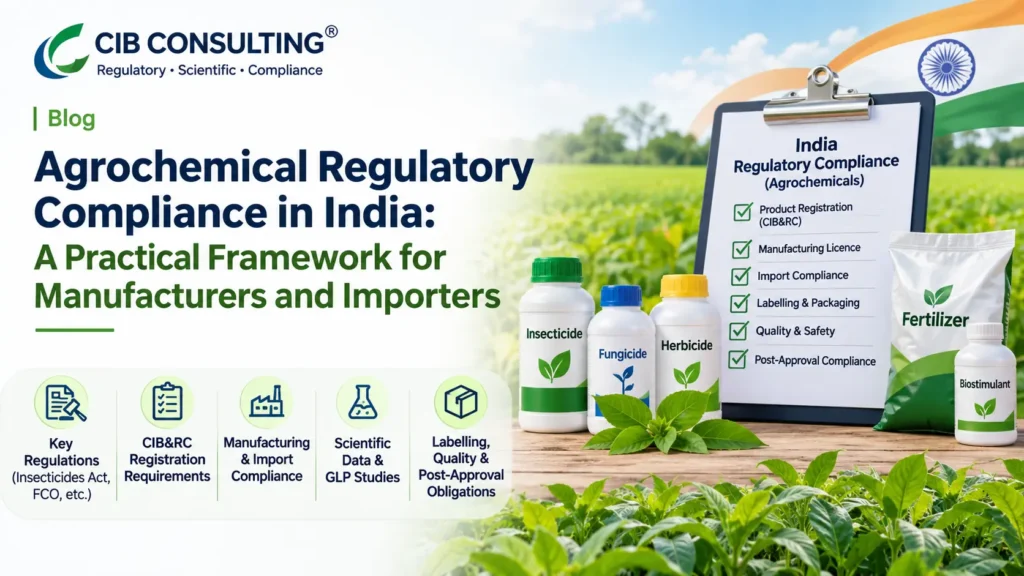
Agrochemical Regulatory Compliance in India: A Practical Framework for Manufacturers and Importers
India's agrochemical industry plays an important role in agricultural productivity, crop protection and food security. With increasing demand for pesticides, herbicides, fungicides, insecticides, fertilizers and biostimulants, manufacturers and importers must follow a well-defined regulatory framework before introducing agricultural input products into the Indian market.
Agrochemical regulatory compliance in India involves more than obtaining product registration. Businesses must understand applicable legislation, product classification, scientific data requirements, manufacturing and import permissions, labelling standards, quality control, environmental obligations and post-approval responsibilities.
For companies planning to manufacture, import, distribute or sell agrochemical products, understanding these requirements is essential to avoid regulatory delays, documentation gaps, product restrictions and compliance-related penalties.
This guide explains the major regulatory requirements, approval processes, documentation responsibilities and practical compliance steps that agrochemical manufacturers and importers should understand before entering or expanding in the Indian market.
What Is Agrochemical Regulatory Compliance in India?
Agrochemical regulatory compliance refers to following the applicable Indian laws, regulations, technical standards and approval procedures governing the development, manufacture, import, packaging, distribution and sale of agricultural chemical products.
These requirements are designed to ensure that agricultural inputs meet prescribed quality standards and that their use does not create unacceptable risks to human health, animals, crops or the environment.
Depending on the product category, regulatory requirements may involve:
- Product registration and regulatory approval.
- Manufacturing and import permissions.
- Scientific efficacy and safety data.
- Chemical composition and quality specifications.
- Packaging and labelling requirements.
- Storage, transportation and distribution compliance.
- Environmental and workplace safety obligations.
- Product traceability and regulatory record maintenance.
- Post-registration changes and ongoing compliance.
The regulatory pathway depends on the product's intended use, composition, formulation and legal classification. A pesticide, fertilizer, biostimulant and biofertilizer should not automatically be treated under the same approval framework.
1. Understanding the Regulatory Framework for Agrochemicals in India
India has different regulatory frameworks for different categories of agricultural inputs. Manufacturers and importers should first identify the legislation applicable to their products.
The following are some of the important regulatory frameworks.
A. Insecticides Act, 1968
The Insecticides Act, 1968 is one of the primary laws governing the import, manufacture, sale, transportation, distribution and use of insecticides in India.
The Act establishes the Central Insecticides Board and Registration Committee (CIB&RC), which plays a central role in evaluating and registering insecticides.
Under Section 9 of the Act, persons intending to import or manufacture an insecticide must apply for registration with the Registration Committee, subject to the applicable requirements.
The registration process involves scrutiny of product information, formulation details and relevant evidence relating to efficacy and safety.
Key compliance areas include:
- Registration of insecticide products.
- Verification of product composition and formulation.
- Submission of prescribed technical and scientific information.
- Compliance with approved specifications and conditions.
- Applicable manufacturing and distribution licences.
- Product packaging and labelling requirements.
- Compliance with restrictions and directions issued by authorities.
Manufacturers and importers should review the Insecticides Act and applicable rules before initiating commercial activities.
B. Insecticides Rules, 1971
The Insecticides Rules, 1971 provide the procedural requirements for implementing the Insecticides Act, 1968.
They cover several operational aspects of insecticide regulation, including:
- Application procedures for registration.
- Manufacturing licence requirements.
- Sale and distribution licences.
- Storage and handling conditions.
- Packaging and labelling.
- Qualifications and responsibilities of relevant personnel.
- Inspection and regulatory enforcement.
Businesses must distinguish between product registration and operational licensing. Obtaining a product registration certificate does not automatically replace the separate licences required for manufacturing, selling, stocking or distributing insecticides.
C. Fertiliser (Control) Order, 1985
The Fertiliser (Control) Order, 1985, commonly known as the FCO, regulates the quality, specifications, manufacture, distribution and sale of fertilisers in India.
It operates under the Essential Commodities Act, 1955.
The FCO establishes requirements relating to:
- Fertilizer specifications and prescribed standards.
- Manufacturer and dealer authorisations.
- Quality control and sampling.
- Packaging and labelling.
- Product composition and declarations.
- Compliance with notified amendments and schedules.
Manufacturers and importers must identify the relevant fertilizer category and verify whether the product meets the applicable specifications under the FCO.
D. Biostimulant Regulations Under the FCO
Biostimulants are regulated under the Fertiliser (Control) Order, 1985.
The Government of India introduced provisions for regulating biostimulants through Notification S.O. 882(E), dated 23 February 2021.
Under the FCO framework, biostimulants are substances, microorganisms or combinations intended to stimulate plant physiological processes and support functions such as nutrient uptake, growth, yield, crop quality and stress tolerance.
Their classification and regulatory requirements depend on their composition, intended function and applicable specifications.
A particularly important development occurred in 2025.
According to the Ministry of Agriculture and Farmers Welfare's clarification dated 9 September 2025, provisional biostimulant registrations became invalid from 17 June 2025. The Government stated that only 146 biostimulant products had been included in Schedule VI at that time.
Therefore, manufacturers and importers should not rely on previously issued provisional certificates without checking their current regulatory status.
They should verify the latest Schedule VI entries, applicable notifications and product-specific requirements before manufacturing, importing or marketing a biostimulant.
2. Product Classification: The First Step Before Regulatory Approval
One of the most important steps in agrochemical regulatory compliance is determining the correct product category.
Incorrect product classification can result in inappropriate applications, incomplete documentation, regulatory delays and potential non-compliance.
Different agricultural inputs may have different regulatory pathways, even when they are used for similar agricultural purposes.
| Product category | Main regulatory framework |
|---|---|
| Insecticides | Insecticides Act, 1968 and Insecticides Rules, 1971 |
| Herbicides | Insecticides Act, 1968 and applicable rules |
| Fungicides | Insecticides Act, 1968 and applicable rules |
| Pesticide formulations | Insecticides Act, 1968 and applicable rules |
| Chemical fertilizers | Fertiliser (Control) Order, 1985 |
| Organic fertilizers | Applicable FCO provisions |
| Biostimulants | FCO, 1985, including Schedule VI |
| Biofertilizers | Applicable FCO provisions and notified specifications |
How Should Manufacturers Determine Product Classification?
Before submitting an application, manufacturers and importers should evaluate:
- Product composition and active ingredients.
- Intended agricultural application.
- Primary function and claimed benefits.
- Chemical, biological or microbial characteristics.
- Existing notified product specifications.
- Applicable government notifications and regulatory definitions.
For example, a product marketed to stimulate plant growth may fall under the biostimulant framework if it satisfies the applicable definition and specifications. However, a product whose intended function and regulatory classification fall under pesticide or plant growth regulator provisions may require a different approval pathway.
Product names and marketing claims alone do not determine legal classification.
3. CIB&RC Registration Requirements for Pesticides in India
The Central Insecticides Board and Registration Committee (CIB&RC) is a key regulatory authority for insecticide registration in India.
It operates under the Department of Agriculture and Farmers Welfare, Ministry of Agriculture and Farmers Welfare.
CIB&RC evaluates applications and relevant technical information to determine whether insecticides meet the applicable regulatory requirements.
Manufacturers and importers should understand the registration process before introducing pesticide products into the Indian market.
Important Aspects of CIB&RC Registration
The registration process may involve:
1. Product identification
The applicant must establish the identity of the proposed insecticide, including its active ingredient, formulation type, concentration and intended use.
2. Technical documentation
Relevant technical documents must be prepared according to the applicable registration category and regulatory requirements.
3. Efficacy information
Scientific evidence may be required to support the product's proposed agricultural use, effectiveness and claims.
4. Toxicological and safety information
Applicable toxicological, environmental and other safety information must be submitted as required by the Registration Committee.
5. Chemical specifications
Information regarding the active ingredient, formulation composition, impurities and quality parameters may be required.
6. Regulatory scrutiny
The submitted application and supporting information are examined by the relevant regulatory authority.
7. Registration approval
The applicant must obtain the required registration before undertaking regulated commercial activities.
Common CIB&RC Registration Categories
Depending on the product and applicable provisions, pesticide registration pathways may include:
- Registration of a new insecticide.
- Registration of an already registered insecticide.
- Registration of a formulation based on a registered technical insecticide.
- Registration for specified manufacturing or import arrangements.
- Registration under applicable provisions for indigenous manufacture.
- Other registration categories recognised under the Act and Rules.
The exact application route, forms, data requirements and eligibility should be confirmed against the current CIB&RC procedures.
4. Agrochemical Manufacturing Licence Requirements
Product registration and manufacturing authorisation are separate regulatory considerations.
Even when a pesticide has received product registration, the manufacturer must obtain the applicable manufacturing licence from the competent licensing authority before commencing regulated manufacturing activities.
Manufacturing licence requirements may vary depending on the product, location and applicable provisions.
Important Manufacturing Compliance Requirements
Manufacturers should evaluate the following areas:
Manufacturing facility
The proposed facility should have suitable infrastructure, plant and machinery, production arrangements and safety facilities.
Technical personnel
Appropriately qualified personnel and expert staff may be required under the applicable licensing provisions.
Quality control systems
Manufacturers should establish procedures for checking raw materials, in-process production and finished product quality.
Approved formulation
The product manufactured must comply with the applicable registration conditions, approved composition and prescribed specifications.
Manufacturing records
Production batches, raw materials, testing information and other required records should be maintained.
Regulatory inspections
Manufacturing facilities may be subject to inspections by authorised regulatory officers.
An important point for manufacturers is that separate manufacturing licences may be required for different manufacturing locations, subject to the applicable rules.
Businesses should therefore assess each proposed facility independently rather than assuming that one licence automatically covers all locations.
5. Agrochemical Import Regulations in India
Importing agrochemical products into India requires careful regulatory planning.
Importers must determine whether their product falls under the Insecticides Act, the FCO or another applicable regulatory framework.
For regulated insecticides, the required registration and import permissions must be obtained in accordance with the applicable law and procedures.
Key Compliance Areas for Agrochemical Importers
Product registration
Verify that the proposed product has the required regulatory registration for the intended import and use.
Manufacturer information
Maintain accurate information about the overseas manufacturer, production facility, product identity and manufacturing source.
Import documentation
Prepare the relevant commercial, technical and regulatory documents required for the proposed transaction.
Product specifications
Ensure that the imported material matches the approved composition and applicable quality requirements.
Customs compliance
Review the applicable customs classification, import policy, documentation and clearance requirements.
Import permits and permissions
Obtain any additional permits or permissions required for the product and intended purpose.
What Should Importers Verify Before Placing an Order?
Before confirming a purchase order with an overseas supplier, importers should verify:
- Whether the product is eligible for import into India.
- Whether the required registration has been obtained.
- Whether the foreign manufacturing source is covered by the applicable approval.
- Whether the formulation and specifications match the approved details.
- Whether any separate import permission is necessary.
- Whether the proposed labelling and packaging comply with Indian requirements.
- Whether the shipment documents are consistent with the regulatory approvals.
For certain chemicals listed under the Insecticides Act but intended for non-insecticidal industrial use, a separate regulatory recommendation and import permission process may apply. The exact requirements should be checked with the competent authorities.
6. Scientific Data and Documentation Requirements
Scientific documentation is an important component of agrochemical regulatory compliance.
Regulatory authorities use submitted scientific evidence to evaluate product identity, efficacy, quality and potential risks.
The type and extent of data required depend on the product, registration category, intended use and applicable regulatory guidelines.
Common Categories of Regulatory Data
| Data category | Purpose |
|---|---|
| Chemistry data | Establishes product identity, composition and specifications |
| Physical and chemical properties | Describes relevant product characteristics |
| Toxicological data | Supports evaluation of potential health hazards |
| Residue data | Helps assess pesticide residues in crops and relevant exposure considerations |
| Bio-efficacy data | Supports the proposed agricultural performance and use claims |
| Environmental data | Supports assessment of environmental behaviour and potential risks |
| Stability data | Helps establish product quality over the specified storage period |
| Analytical methods | Supports reliable identification and measurement of relevant components |
Not every product requires every category of study. Applicants should identify the applicable data requirements before commissioning studies.
Why Is GLP Data Generation Important?
Good Laboratory Practice (GLP) provides a quality system for planning, performing, monitoring, recording, reporting and archiving non-clinical laboratory studies.
For agrochemical regulatory submissions, GLP-compliant studies may be relevant where required by the applicable regulatory framework.
Manufacturers and importers should pay attention to:
- Suitability of the testing facility.
- Study protocols and approved procedures.
- Equipment calibration and maintenance.
- Sample identification and traceability.
- Raw data and quality assurance records.
- Final study reports.
- Proper record retention and archiving.
A study should not be considered acceptable simply because it was conducted by a laboratory. Its relevance, scientific validity, study design and compliance with applicable regulatory requirements must also be assessed.
7. Packaging and Labelling Compliance for Agrochemical Products
Packaging and labelling are important parts of agrochemical product compliance because labels communicate product identity, approved uses, handling instructions and safety information.
Pesticide labels and leaflets must comply with the applicable provisions of the Insecticides Rules, approved product conditions and relevant regulatory directions.
Depending on the product and packaging, other applicable requirements may also need to be considered.
Important Label and Packaging Considerations
- Approved product name and formulation.
- Active ingredient and concentration.
- Manufacturer or importer identification.
- Registration and applicable licence details.
- Approved crop and pest information.
- Directions for use and dosage.
- Precautionary statements and safety instructions.
- Relevant first-aid and handling information.
- Batch identification and manufacturing information.
- Storage and disposal instructions.
- Other declarations prescribed by the applicable rules.
Importers and manufacturers should ensure that labels are consistent with the product's approved regulatory details.
They should not introduce additional crop uses, performance claims or dosage recommendations without confirming that these are permitted under the applicable approval.
Role of Legal Metrology Requirements
The Legal Metrology Act, 2009 and the Legal Metrology (Packaged Commodities) Rules, 2011 govern applicable declarations on pre-packaged commodities.
Depending on the product and packaging, declarations relating to manufacturer, packer or importer details, net quantity, country of origin for imported goods and retail sale price may be relevant.
Businesses should assess the applicability of these provisions alongside product-specific pesticide or fertilizer labelling requirements.
8. Quality Control and Product Testing
Quality assurance should be integrated into the entire agrochemical manufacturing and supply chain.
A product may have obtained the required regulatory approval, but its commercial batches must continue to meet the applicable specifications and quality requirements.
Manufacturers should establish a documented quality management process covering:
Raw material inspection: Verify incoming active ingredients, solvents, additives and other materials against approved specifications.
In-process quality checks: Monitor critical production parameters throughout manufacturing.
Finished product testing: Check relevant quality parameters before product release.
Batch traceability: Maintain records linking raw materials, production batches and finished goods.
Stability monitoring: Evaluate product stability under relevant storage conditions.
Deviation management: Investigate and document deviations, non-conformities and corrective actions.
Product complaints: Maintain a system for receiving, investigating and resolving product quality complaints.
A strong quality control system helps manufacturers maintain product consistency, support inspections and reduce the risk of non-compliant batches entering the market.
9. Environmental, Health and Safety Compliance
Agrochemical manufacturing and handling may involve chemicals that require specific environmental and workplace safety controls.
Businesses should assess applicable environmental permissions, occupational safety requirements and waste management obligations before starting operations.
Depending on the facility and activities, relevant requirements may include:
- Consent to Establish and Consent to Operate from the applicable State Pollution Control Board or Pollution Control Committee.
- Applicable environmental clearances, where required.
- Hazardous and Other Wastes (Management and Transboundary Movement) Rules, 2016, where applicable.
- Safe storage and handling of chemicals.
- Appropriate personal protective equipment.
- Emergency response and spill management procedures.
- Worker training and workplace safety arrangements.
- Effluent and emission management, where applicable.
- Waste segregation, documentation and authorised disposal.
The applicable obligations depend on the nature of manufacturing activities, chemicals handled, waste generated and location of the facility.
Importers that only trade in finished products may have different obligations from businesses operating chemical manufacturing facilities.
10. Post-Registration Compliance: Responsibilities After Approval
Regulatory compliance does not end when a product receives registration.
Manufacturers and importers must continue to comply with the conditions attached to their approvals and the laws applicable to their business activities.
Post-registration compliance is particularly important when companies introduce product changes, modify manufacturing arrangements or expand distribution.
Key Post-Registration Responsibilities
1. Maintain approved product specifications
Ensure that commercial production remains consistent with the applicable approved formulation and specifications.
2. Monitor regulatory amendments
Track notifications, circulars, amendments and directions issued by relevant authorities.
3. Manage manufacturing source changes
Assess the regulatory implications of changing manufacturing locations, sources or other approved particulars.
4. Review labelling and packaging
Ensure that packaging, labels and product information remain consistent with current regulatory approvals.
5. Maintain technical records
Preserve relevant registration certificates, licences, test reports, production records and other required documentation.
6. Monitor product quality
Implement procedures for handling complaints, quality deviations, batch failures and other product-related issues.
7. Manage approval renewals and changes
Track applicable validity periods, renewals, endorsements and other regulatory submissions.
8. Cooperate with inspections
Maintain records and operational procedures required for regulatory inspections and compliance verification.
Companies should establish a post-registration compliance calendar to avoid missed regulatory obligations.
11. Common Regulatory Compliance Challenges Faced by Agrochemical Companies
Despite the availability of regulatory procedures, manufacturers and importers may face practical challenges while managing product approvals and ongoing compliance.
Some common challenges include:
| Compliance challenge | Potential impact | Recommended approach |
|---|---|---|
| Incorrect product classification | Wrong application route | Conduct regulatory classification assessment |
| Incomplete technical documentation | Application queries and delays | Prepare a document checklist before submission |
| Inadequate scientific data | Difficulty supporting product claims | Identify applicable study requirements early |
| Formulation inconsistencies | Quality and approval concerns | Establish approved formulation controls |
| Manufacturing source changes | Regulatory non-compliance | Assess approval requirements before making changes |
| Incorrect product labelling | Labelling violations and product restrictions | Conduct regulatory label review |
| Missed regulatory amendments | Outdated compliance practices | Monitor official notifications regularly |
| Poor documentation management | Inspection and audit difficulties | Maintain centralised regulatory records |
How Can Companies Reduce Regulatory Delays?
Businesses can improve regulatory readiness through a structured approach:
- Conduct a product-specific regulatory assessment.
- Identify the applicable legislation and approval route.
- Prepare a detailed documentation checklist.
- Review scientific data gaps before application submission.
- Verify the manufacturing or import arrangement.
- Check the consistency of technical and commercial documents.
- Review packaging and labelling requirements.
- Establish a system for monitoring application status.
- Maintain a post-approval compliance programme.
This approach helps businesses identify potential issues earlier and reduce avoidable documentation errors.
12. Practical Agrochemical Regulatory Compliance Checklist for Manufacturers and Importers
Before manufacturing, importing or marketing an agricultural input product in India, businesses should review the following checklist.
Product and Regulatory Assessment
- Identify the product's legal classification.
- Determine the applicable regulatory framework.
- Verify current product registration requirements.
- Review relevant government notifications and amendments.
- Confirm whether additional product-specific approvals are necessary.
Registration and Documentation
- Prepare product composition and technical specifications.
- Identify applicable toxicological and efficacy data requirements.
- Review relevant laboratory study reports.
- Prepare the required application documents.
- Verify the registration status and applicable approval conditions.
Manufacturing and Import
- Obtain applicable manufacturing licences.
- Verify import eligibility and required permissions.
- Check manufacturing source and facility details.
- Establish appropriate quality control procedures.
- Maintain production and import records.
Packaging and Distribution
- Review product labels and leaflets.
- Verify applicable packaging declarations.
- Check storage and transportation conditions.
- Maintain batch traceability.
- Verify applicable sale and distribution licences.
Ongoing Compliance
- Monitor regulatory notifications and amendments.
- Track licence validity and renewal dates.
- Review product changes before implementation.
- Maintain technical and regulatory records.
- Establish a complaint and corrective action system.
- Prepare for inspections and compliance reviews.
This checklist is a general planning tool. The final requirements should be determined according to the product category, business activity and current regulatory provisions.
13. How Can Regulatory Consulting Support Agrochemical Manufacturers and Importers?
Managing regulatory requirements can be challenging, particularly for companies dealing with multiple products, manufacturing facilities, international suppliers and different agricultural input categories.
Regulatory consulting can help businesses understand the applicable legal framework, prepare technical documentation and organise their regulatory submissions.
A structured consulting approach may include:
- Regulatory pathway identification.
- Product classification assessment.
- CIB&RC registration guidance.
- Technical dossier preparation support.
- Scientific data gap assessment.
- GLP study planning and documentation coordination.
- Manufacturing and import compliance guidance.
- Product labelling and documentation review.
- Post-registration regulatory support.
- Regulatory change monitoring.
Working with an experienced regulatory affairs professional can help businesses identify documentation gaps and understand their compliance responsibilities before initiating important commercial activities.
CIB Consulting can be considered as a regulatory consulting resource for businesses seeking guidance on agrochemical regulatory requirements, pesticide registration and related technical documentation. Companies should evaluate the specific scope of support required for their products and regulatory pathway.
Explore CIB Consulting to learn more about its regulatory consulting services.
Frequently Asked Questions About Agrochemical Regulatory Compliance in India
1. What is agrochemical regulatory compliance in India?
Agrochemical regulatory compliance in India means following applicable laws, registration requirements, manufacturing and import permissions, technical standards, labelling rules and safety obligations for agricultural input products.
2. Which law regulates pesticides in India?
The Insecticides Act, 1968 and the Insecticides Rules, 1971 are the primary regulatory framework for insecticides in India. They govern relevant registration, manufacturing, import, sale, distribution and other compliance requirements.
3. What is CIB&RC registration?
CIB&RC registration is the regulatory approval process for insecticides under the Insecticides Act, 1968. The Registration Committee evaluates relevant product information, formulation details and supporting scientific evidence before granting registration, subject to applicable provisions.
4. Is product registration sufficient to manufacture pesticides in India?
No. Product registration and manufacturing licensing are separate regulatory requirements. A manufacturer must obtain the applicable manufacturing licence from the competent licensing authority in addition to meeting product registration requirements.
5. What are the requirements for importing agrochemicals into India?
Importers must identify the applicable product category, obtain the required product registration and import permissions, verify manufacturing source and product specifications, and comply with relevant customs and other regulatory requirements.
6. Which regulations govern fertilizer products in India?
The Fertiliser (Control) Order, 1985, issued under the Essential Commodities Act, 1955, provides the primary framework for regulating fertilizer specifications, quality, manufacture, distribution and sale.
7. Are biostimulants regulated in India?
Yes. Biostimulants are regulated under the Fertiliser (Control) Order, 1985. Their applicable specifications and requirements are addressed through Schedule VI and related government notifications. Businesses should verify the latest notified product status before marketing a biostimulant.
8. What scientific data may be required for pesticide registration?
Depending on the registration category, scientific information may include chemistry, toxicology, bio-efficacy, residue, environmental safety, stability and analytical data. The exact requirements must be checked against the applicable regulatory guidelines.
9. What is the importance of GLP in agrochemical registration?
Good Laboratory Practice provides a quality framework for conducting, documenting and reporting non-clinical laboratory studies. GLP-compliant studies may support regulatory submissions where required by the applicable regulatory framework.
10. Do agrochemical companies need environmental permissions?
Depending on their activities and facility classification, manufacturers may require environmental permissions such as Consent to Establish and Consent to Operate from the relevant State Pollution Control Board or Pollution Control Committee. Applicable waste management and safety requirements must also be assessed.
11. What happens if an agrochemical company fails to comply with regulatory requirements?
Depending on the nature of the violation, consequences may include regulatory notices, product restrictions, licence-related action, seizure, penalties or prosecution under applicable legislation. The specific consequences depend on the relevant law and circumstances.
12. Why is post-registration compliance important?
Post-registration compliance ensures that products continue to meet approved specifications and that manufacturers and importers follow applicable conditions relating to formulation, manufacturing, labelling, documentation and regulatory changes.
Conclusion: Build a Strong Regulatory Compliance Framework Before Entering the Indian Agrochemical Market
Agrochemical regulatory compliance in India requires a coordinated understanding of product classification, applicable legislation, scientific data, registration, manufacturing, imports, packaging, quality assurance and post-registration responsibilities.
For manufacturers and importers, the most effective approach is to evaluate regulatory requirements before investing in product development, manufacturing arrangements or commercial imports.
A well-organised compliance framework can help businesses reduce avoidable regulatory risks, maintain product quality, support transparent operations and establish a more reliable route to market.
As India's agricultural input regulatory landscape continues to evolve, businesses should regularly review official notifications and seek qualified regulatory guidance for product-specific decisions.
Need guidance on agrochemical regulatory compliance in India? Connect with CIB Consulting to understand the regulatory requirements relevant to your product, documentation and business operations.
Website: https://cibconsulting.in/